
Top 10 Lumbar Traction Table Types for Global Buyers

Choosing a Lumbar Traction Table is not simply a matter of comparing prices or motor strength. Global buyers must examine clinical purpose, patient comfort, adjustment range, construction quality, service support, and documentation. A table used in a busy rehabilitation clinic faces different demands from one used by a small private practice.

Dr. James Cyriax, a pioneer of orthopedic medicine, described traction as “a force applied to a part of the body to stretch it.” This principle remains useful, but modern equipment adds important controls. Split-table movement, pelvic fixation, treatment angles, emergency release systems, and programmable force settings can influence daily usability. Operators should also verify training requirements, maintenance procedures, warranty terms, and applicable regional safety standards. Specifications alone are not enough.

This guide reviews the top ten Lumbar Traction Table types for international purchasers. It compares practical designs, including manual, electric, motorized, split-table, and multifunctional systems. Each category is considered through a buyer’s real-world lens: setup time, patient transfer, cleaning, noise, durability, and after-sales support. Small details matter. A loose strap or unclear control panel can slow treatment and reduce confidence.

No ranking is flawless. Some categories overlap, and a premium table may still be unsuitable for a clinic with limited space. Buyers should confirm clinical requirements with qualified healthcare professionals before purchase. They should also request product records from manufacturers, not rely only on polished catalog images. The best choice is rarely the most expensive one. It is the table that fits the intended patients, trained operators, facility, budget, and local compliance expectations.
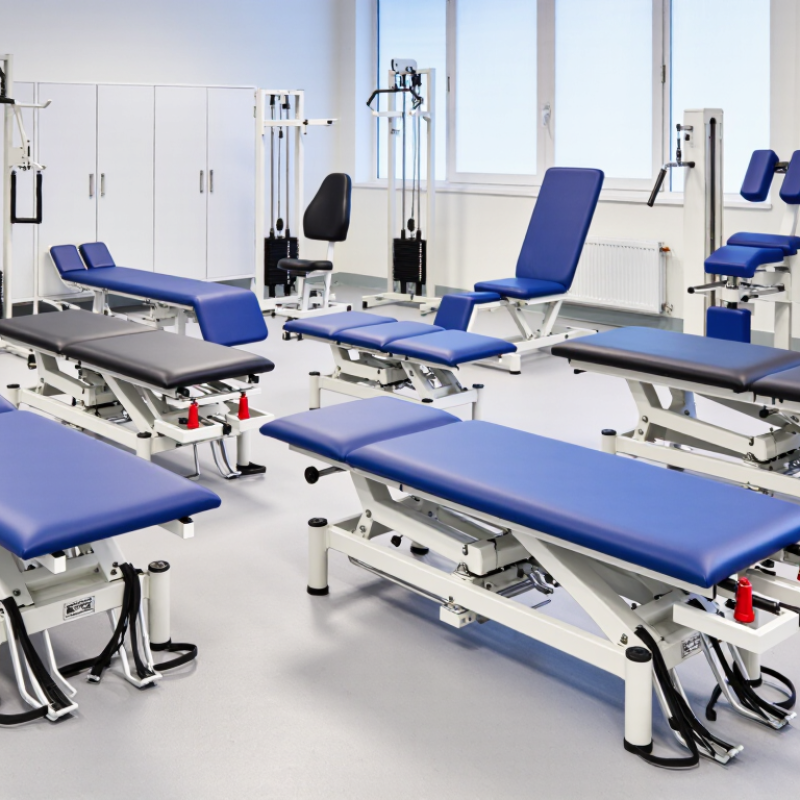
Top 10 Lumbar Traction Table Types for Global Buyers

Lumbar Traction Tables: Definition, Purpose, and Clinical Applications

Lumbar traction tables are clinical devices designed to apply controlled pulling force along the spine. They may use motorized, pneumatic, or manual systems. Common configurations include split-table, fixed-table, supine, prone, and pelvic-tilt designs. Each type changes patient positioning, force delivery, and therapist access.

The purpose is specific. Traction can temporarily reduce spinal loading, improve comfort, and support movement during rehabilitation. It is not a universal cure. The World Health Organization reported that low back pain affected about 619 million people globally in 2020, with projections reaching 843 million by 2050. That scale explains growing interest in structured, non-surgical care. However, the Cochrane review on traction found little clinically important benefit for many patients with chronic low back pain. Results may differ when nerve-root irritation is present.

Clinical application requires assessment, not guesswork. Practitioners may consider traction for selected patients with radiating leg pain, suspected disc-related symptoms, or limited mobility. Treatment usually combines traction with exercise, education, and monitoring. Short sessions matter. Force, angle, duration, and symptom response should be recorded after every visit. The 2021 JOSPT clinical practice guideline suggests possible benefit for a subgroup with signs of nerve-root compression, but the evidence remains limited. That uncertainty deserves attention. A table that feels sophisticated can still be poorly matched to the patient. Screening for fracture risk, severe osteoporosis, infection, malignancy, and other contraindications remains essential before use.

The Top 10 Lumbar Traction Table Types and Their Core Features

Global buyers usually compare lumbar traction tables by movement, control, and patient positioning. The World Health Organization reported that low back pain affected 619 million people in 2020, with cases projected to reach 843 million by 2050. The Global Burden of Disease Study also identifies low back pain as a leading cause of disability. Demand is real, but equipment selection requires caution.

The ten main types include man​​ual traction tables with therapist-controlled force; motorized tables with programmable pull cycles; static traction tables for steady force; intermittent tables for repeated loading and release; flexion-distraction tables with segmented movement; split tables that separate sections during traction; hydraulic tables offering smooth height adjustment; electric decompression tables with digital controls; portable folding tables for mobile clinics; and heat-assisted traction tables combining controlled warmth with pulling force. Core features vary widely. Some support pelvic belts, adjustable head sections, emergency release systems, or patient weight limits. A quiet motor matters in a small treatment room.

Clinical evidence is less decisive than marketing language suggests. A Cochrane review found limited or inconsistent support for traction in many chronic low-back-pain cases. That point should remain visible. Tables do not replace assessment, positioning skill, or treatment monitoring. Buyers should verify force accuracy, frame stability, cleaning access, maintenance records, and local safety certification. Specifications can look impressive. Real-world reliability is harder to measure.

How Each Lumbar Traction Table Type Works

Lumbar traction tables differ by force delivery, patient position, and control.

A manual traction table uses the therapist’s hands and table leverage to create short, measured pulls.

A motorized table uses an electric actuator, allowing preset force, hold time, and release cycles. Its consistency helps with repeated treatment, though poor settings can still irritate symptoms.

A split-table design separates the sections beneath the torso and pelvis, creating controlled movement between them.

A flexion-distraction table lowers one end while the clinician guides the lumbar segment through gentle flexion.

A pelvic traction table secures the pelvis with a belt and applies a longitudinal pull from the lower frame.

A supine traction table supports the patient face up, often with pillows under the knees.

A prone model positions the patient face down and may suit clinicians who need direct access to the back.

Position changes matter.

Static traction holds a steady force for a selected period.

Intermittent traction alternates pulling and releasing, which some patients tolerate better.

Computerized traction combines sensors, programmed cycles, and adjustable force limits.

These categories can overlap; a computerized table may also be split-table or motorized. That makes comparison less tidy.

In practice, clinicians check belt placement, patient comfort, neurological findings, and post-treatment response.

Pain relief is not proof of structural correction.

Selection should reflect the diagnosis, table stability, service support, electrical standards, and operator training.

Evidence and patient response should guide adjustments, not attractive specifications alone.

Some protocols remain uncertain.

That deserves honest discussion.

Key Differences in Design, Function, and Patient Use

Lumbar traction tables differ in structure, control, and patient positioning. The ten common types include manual, motorized, split-table, flexion-distraction, pelvic-tilt, inversion, static, intermittent, computerized, and portable designs. Manual tables depend on clinician skill and direct force adjustment. Motorized models deliver measured cycles, while split-table systems add segmental movement. Flexion-distraction tables combine traction with controlled bending. That feels different.

Static traction holds a steady pull. Intermittent traction alternates loading and release, which some patients tolerate better. Computerized tables can record force, duration, and treatment history. Portable units suit smaller clinics, but they often provide fewer positioning options. Inversion designs use body weight, requiring careful screening for dizziness, hypertension, or balance problems. Patient use matters more than impressive mechanics. A tall patient may need longer pelvic support, while an older adult may require easier transfers and lower entry height.

The World Health Organization reported that low back pain affected 619 million people in 2020 and may reach 843 million by 2050. This increases demand, but demand does not prove effectiveness. A Cochrane review found little or no meaningful benefit from traction for many low-back-pain patients, especially when used alone. Therefore, global buyers should compare safety controls, therapist access, weight limits, and cleaning procedures, not only maximum pulling force. In practice, a smooth 30-kilogram cycle may be more useful than a powerful setting patients fear. Evidence also remains uneven across patient groups. That deserves caution.

How Global Buyers Can Compare and Select the Right Table

Global buyers should compare lumbar traction tables by clinical purpose, not by rankings alone. Common options include manual, motorized, split-platform, flexion-distraction, and portable designs. Each type creates a different workflow in a treatment room. A motorized table may support precise force settings, while a manual model can be easier to maintain. Portable tables save space, but they may offer fewer adjustments.

Check the table’s working load, height range, pelvic and thoracic support, traction direction, and emergency release. Ask for test reports, user manuals, electrical specifications, and maintenance schedules. Requirements vary by destination, so verify local medical-device rules before placing an order. Do not rely only on attractive product photos. Examine frame welds, locking points, upholstery seams, and the controller’s response. Small details matter.

A practical comparison should include training, spare parts, delivery terms, and service response time. A lower purchase price may become expensive when a replacement actuator takes months to arrive. Request a demonstration video with a visible scale and moving components. Better still, arrange an independent inspection before shipment. No table is perfect. Some suppliers may provide incomplete data, and buyers can overlook noise, room clearance, or staff comfort during daily use. Record these issues in a scoring sheet, then match the table with patient needs, operator experience, facility space, and local support.

Top 10 Lumbar Traction Table Types for Global Buyers - How Global Buyers Can Compare and Select the Right Table

Table Type Traction Mechanism Typical Patient Position Typical Traction Range Typical Working Load Common Table Width Main Advantages Important Limitations Best Fit for Global Buyers
Motorized Electric Lumbar Traction Table Electric motor with programmable pulling force, treatment time, rest time and cycling modes. Supine or prone, depending on the pelvic harness and table design. Approximately 20–90 kgf Approximately 120–200 kg 55–70 cm Precise, repeatable settings; suitable for frequent clinical use; often includes emergency stop controls. Requires stable electrical power, operator training and regular mechanical servicing. Rehabilitation hospitals, physiotherapy clinics and buyers seeking programmable treatment protocols.
Manual Crank Traction Table Hand-operated crank, lever or mechanical screw system with direct force adjustment. Usually supine; some models support prone treatment. Approximately 10–60 kgf Approximately 120–180 kg 55–70 cm Low purchase cost, simple construction and minimal dependence on electricity. Force consistency depends on the operator; fewer automatic programs and less precise monitoring. Small clinics, low-resource facilities, training centers and markets with unreliable power supply.
Split-Table Lumbar Traction Table Powered or manual traction separates two table sections to create controlled longitudinal movement. Supine or prone, with the pelvis secured by a suitable harness. Approximately 20–90 kgf Approximately 140–200 kg 60–75 cm Can reduce friction between the patient and table surface; supports controlled lumbar distraction. More moving parts require alignment checks, maintenance and proper operator setup. Professional outpatient clinics requiring repeatable lumbar traction and efficient patient positioning.
Fixed-Top Traction Table with Pelvic Harness Traction unit pulls through a pelvic harness while the main tabletop remains fixed. Primarily supine; prone use depends on the table and harness configuration. Approximately 10–80 kgf Approximately 120–180 kg 55–70 cm Simple patient transfer, straightforward setup and generally lower mechanical complexity. Higher surface friction may affect force transfer; careful harness positioning is essential. General physiotherapy practices that need lumbar traction without a fully split tabletop.
Flexion-Distraction Traction Table Combination of manual or powered longitudinal traction with segmented pelvic and lumbar motion. Usually prone, with the abdomen and pelvis supported on a segmented surface. Approximately 10–70 kgf Approximately 120–180 kg 55–75 cm Offers positioning flexibility and controlled segmental movement in addition to traction. Requires specialized operator training; the mechanism may increase purchase and maintenance costs. Spinal rehabilitation centers and practices using manual therapy combined with traction techniques.
Inversion Traction Table Gravity-assisted traction produced by tilting the patient body below or near the horizontal position. Strapped supine position with ankle or leg supports. Gravity-assisted; not normally specified in kgf Approximately 100–150 kg 55–75 cm Does not require a traction motor; can provide adjustable body-angle-based unloading. Not equivalent to motorized lumbar traction; requires careful screening, secure restraints and adequate clearance. Fitness, wellness and selected clinical environments where gravity-assisted positioning is appropriate.
Portable Folding Traction Table Compact manual or electric traction assembly integrated into a foldable or transportable frame. Usually supine; patient positioning options vary by model. Approximately 10–60 kgf Approximately 100–150 kg 50–65 cm Easy to transport, store and install; useful for mobile therapy services and small treatment rooms. Usually has a lower working load, smaller surface and fewer adjustment options than full-size tables. Home-care providers, mobile therapists, rural clinics and buyers with limited floor space.
Hydraulic Traction Table Hydraulic cylinder or pump controls table height, section movement or traction force. Supine or prone, depending on the tabletop configuration. Approximately 20–80 kgf Approximately 140–220 kg 60–75 cm High lifting capacity, smooth height adjustment and reduced dependence on electronic controls. Hydraulic leaks, fluid maintenance and replacement-part availability must be considered. High-volume clinics and facilities prioritizing robust height adjustment and patient transfer support.
Three-Section Electric Treatment Table with Traction Module Electric height and section adjustment combined with an integrated or attachable traction module. Supine, prone, semi-reclined or seated-assisted positions, depending on section movement. Approximately 10–80 kgf Approximately 150–250 kg 60–80 cm Multi-purpose platform for traction, examination, exercise preparation and general physiotherapy. Traction performance may be less specialized than a dedicated split-table system; more electrical components require service support. Clinics needing one versatile treatment platform for several therapy procedures.
Bariatric Lumbar Traction Table Reinforced electric or hydraulic traction system with heavy-duty frame, wider surface and high-capacity harness. Supine or prone, subject to the manufacturer’s stated configuration and safety limits. Approximately 20–100 kgf Approximately 200–300 kg or higher 70–90 cm Improved stability, wider support surface and greater patient capacity than standard treatment tables. Requires more floor space, stronger installation surfaces and careful verification of load ratings. Hospitals and rehabilitation facilities serving a broad range of patient body sizes.

Buyer note: The specifications shown are representative market ranges for comparison only. Actual force, load capacity, dimensions, electrical requirements, safety features and applicable certifications vary by model and destination market. Buyers should verify local medical-device regulations, voltage and frequency requirements, emergency-stop functions, warranty coverage, spare-parts availability and operator training before purchase.

preloader